Coaching has become a practical way for people to improve their performance, make better decisions, and achieve meaningful goals. Whether someone wants to advance their career, develop leadership skills, build confidence, or create a healthier work-life balance, coaching provides a structured process for moving forward. Unlike traditional advice, coaching focuses on helping individuals discover their own solutions and take responsibility for their progress.
Many people know what they want to change but struggle to turn their intentions into action. A professional might want a promotion but feel uncomfortable speaking up in meetings. A business owner might have ambitious plans but lack clear priorities. Coaching helps bridge the gap between knowing what matters and doing something about it. Through focused conversations, practical exercises, and measurable commitments, it turns broad ambitions into realistic steps.
What Is Coaching and How Does It Work?
Coaching is a collaborative process in which a trained professional helps a client clarify goals, recognize obstacles, develop strategies, and improve performance. The coach does not simply provide instructions or tell clients how to live. Instead, the coach uses questions, reflection, feedback, and structured exercises to encourage independent thinking.
A central principle of coaching is that lasting change requires personal involvement. When individuals understand why they make certain choices, they become better equipped to change unhelpful habits.
For example, someone experiencing difficulties with time management might initially believe the solution is a stricter schedule. Through coaching, they may discover that their real challenge is accepting too many responsibilities or avoiding difficult conversations. Addressing those underlying behaviors often produces better results than simply downloading another planning application.
Coaching vs. Mentoring, Consulting, and Therapy
Although these approaches sometimes overlap, they serve different purposes.
| Approach | Main Focus | Typical Method |
|---|---|---|
| Coaching | Achieving goals and improving performance | Questions, reflection, accountability |
| Mentoring | Learning from an experienced person | Guidance, shared experience, advice |
| Consulting | Solving specialized problems | Expert analysis and recommendations |
| Therapy | Addressing psychological or emotional difficulties | Clinical assessment and therapeutic treatment |
Coaching generally focuses on present circumstances and future actions. It is not a substitute for mental health treatment, particularly when someone experiences significant psychological distress.
Main Types of Coaching
Coaching is not limited to one profession or personal challenge. Different specializations address different needs, although the fundamental process remains similar.
| Coaching Type | Primary Purpose | Common Goals |
|---|---|---|
| Life coaching | Improve personal direction and satisfaction | Confidence, habits, priorities |
| Career coaching | Support professional development | Career changes, interviews, promotions |
| Executive coaching | Strengthen leadership effectiveness | Decision-making, communication, delegation |
| Business coaching | Improve business performance | Strategy, productivity, operations |
| Health and wellness coaching | Support sustainable lifestyle habits | Exercise consistency, sleep routines, stress management |
| Performance coaching | Develop specific abilities | Focus, preparation, skill improvement |
Life Coaching
Life coaching helps individuals examine their priorities, habits, relationships, and personal ambitions. It is particularly useful during periods of transition, such as changing careers, becoming a parent, moving to a new city, or reconsidering long-term goals.
A life coach might help someone establish stronger boundaries, improve daily routines, or identify what a satisfying personal life actually means to them.
Career and Executive Coaching
Career coaching focuses on professional choices, workplace challenges, and long-term development. Clients may work on interview preparation, negotiation, networking, or transitioning into new industries.
Executive coaching is often more closely connected to leadership responsibilities. It can help managers communicate expectations, navigate conflict, motivate employees, and make decisions under uncertainty.
Business and Performance Coaching
Business coaching supports entrepreneurs and managers who need clearer priorities, stronger processes, and better execution. A coach might help a founder identify operational bottlenecks or establish accountability for strategic goals.
Performance coaching concentrates on developing particular capabilities. It is useful when someone already understands their objectives but needs to improve consistency, preparation, or execution.
Who Can Benefit From Coaching?
Coaching is useful when a person has a meaningful goal, is willing to examine their behavior, and can commit to practical action. Clients do not need to be executives, entrepreneurs, or high achievers to benefit.
Some people begin coaching because they feel stuck. Others are already successful but want to improve a particular aspect of their performance.
| Situation | Possible Coaching Goal | Expected Practical Outcome |
|---|---|---|
| Feeling stuck professionally | Explore career direction | Clearer career options and next steps |
| Struggling with productivity | Improve planning habits | More consistent completion of priorities |
| Facing leadership challenges | Develop management skills | Clearer communication and delegation |
| Experiencing low confidence | Strengthen self-belief and action | Greater willingness to take appropriate risks |
| Managing a major transition | Create a realistic adjustment plan | Better preparation and decision-making |
Coaching is most valuable when the client participates actively. Someone expecting the coach to provide every answer may feel disappointed. Someone prepared to reflect honestly and test new approaches is more likely to make progress.
The objective is not to become dependent on regular coaching sessions. Effective coaching should strengthen a person’s ability to solve problems independently.
What Happens During a Coaching Session?
A coaching session is typically a focused conversation with an agreed objective. Sessions often last between 45 and 60 minutes, although formats vary.
The coach creates space for the client to explore a challenge without unnecessary interruptions. Rather than jumping immediately to solutions, the conversation examines what is happening, why it matters, and what could change.
| Session Stage | What Happens | Purpose |
|---|---|---|
| Check-in | Review recent progress and challenges | Identify what needs attention |
| Goal selection | Choose one clear focus | Prevent an unfocused discussion |
| Exploration | Examine assumptions, obstacles, and options | Develop deeper understanding |
| Action planning | Select realistic next steps | Turn insights into behavior |
| Accountability | Agree on measures and follow-up | Support continued progress |
The best sessions are not necessarily the ones that feel most motivational. Sometimes progress comes from recognizing an uncomfortable pattern or acknowledging that an existing strategy is not working.
A productive session should usually end with clarity about the next action, how it will be completed, and what evidence will indicate progress.
Powerful Questions Used in Coaching
Questions are among the most important coaching tools because they encourage clients to examine problems from different perspectives.
| Coaching Question | Intended Benefit |
|---|---|
| What do you really want to achieve? | Clarifies the desired outcome |
| What is preventing you from moving forward? | Identifies obstacles |
| Which assumptions might be limiting your choices? | Challenges untested beliefs |
| What options have you not considered? | Expands possible solutions |
| What would meaningful progress look like? | Establishes success criteria |
| What specific action can you take this week? | Encourages immediate implementation |
Effective questions are open-ended, relevant, and nonjudgmental. They invite thinking rather than pushing the client toward an answer preferred by the coach.
Essential Coaching Methods and Techniques
Professional coaches use different methods depending on the client’s objectives, personality, and circumstances. No single technique works equally well for everyone.
One widely used framework is the GROW model, which organizes coaching conversations around goals, current reality, available options, and the client’s commitment to action.
| Technique | How It Works | Best Use |
|---|---|---|
| GROW model | Examines Goal, Reality, Options, and Will | Structured problem-solving |
| SMART goals | Defines specific, measurable, achievable, relevant, time-bound goals | Clear action planning |
| Active listening | Attends carefully to language, emotions, and context | Understanding underlying concerns |
| Cognitive reframing | Explores alternative interpretations | Challenging limiting assumptions |
| Accountability tracking | Reviews agreed actions and outcomes | Maintaining consistency |
| Strengths exploration | Identifies abilities that can support improvement | Building confidence and effectiveness |
The GROW Coaching Model
The GROW model helps transform an unclear concern into a manageable plan.
First, the client defines the goal. Next, they examine their current reality, including challenges and available resources. The conversation then explores possible options before identifying concrete commitments.
Imagine a manager who wants to delegate more effectively. Their goal is to reduce unnecessary involvement in routine decisions. Their current reality includes unclear responsibilities and a habit of checking every task. Possible options include redefining decision-making authority, introducing brief weekly updates, and giving employees greater autonomy.
The final step is selecting one or two actions to test.
Active Listening and Constructive Feedback
Listening in coaching involves more than hearing words. Coaches pay attention to contradictions, repeated concerns, and assumptions that might otherwise go unnoticed.
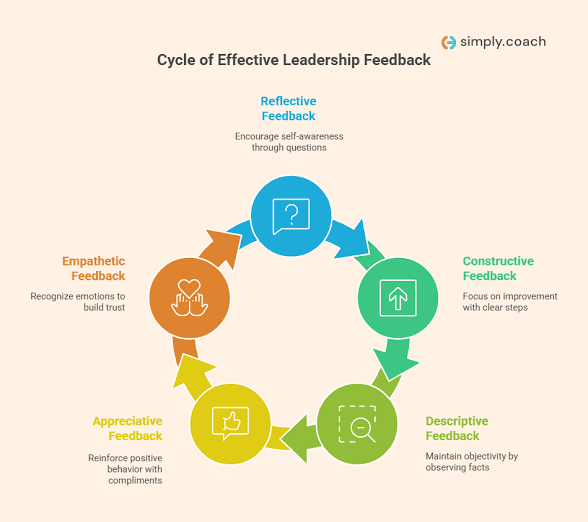
Feedback should be specific and useful. Instead of telling a client they lack confidence, a coach might point out that the client repeatedly minimizes their achievements when discussing career opportunities.
That observation creates an opportunity to explore a behavior rather than criticize a personality trait.
How to Set Effective Coaching Goals
Coaching becomes more useful when goals are clearly defined. Broad ambitions such as “be more successful” or “feel more confident” offer little guidance because they do not explain what should change.
A stronger goal describes a meaningful result and identifies behaviors within the client’s control.
For example, instead of saying “I want to become a better leader,” a client could choose to improve delegation by assigning clear ownership of three recurring responsibilities within the next month.
Effective coaching goals usually include:
- A specific outcome: Define exactly what needs to improve.
- Personal relevance: Explain why the objective matters.
- Observable evidence: Identify behaviors or results that demonstrate progress.
- A realistic timeframe: Establish a target without creating unnecessary pressure.
- Practical actions: Choose steps that fit actual resources and responsibilities.
Not every goal can be measured numerically. Improved communication, better decision-making, and stronger boundaries may require a combination of self-reflection, observable behavior, and feedback from other people.
The important point is to establish a clear basis for evaluating change.
Turning Coaching Insights Into Daily Action
Understanding a problem is useful, but insight alone rarely produces lasting improvement. The real test of coaching occurs between sessions, when clients apply what they have learned.
Small, repeatable actions are often easier to sustain than dramatic changes.
Consider someone trying to improve workplace communication. Rather than promising to become more assertive immediately, they might begin by preparing one question before every team meeting. After that behavior becomes comfortable, they could practice expressing disagreement respectfully or requesting clarification when expectations are unclear.
This gradual approach makes progress observable and reduces unnecessary pressure.
Building an Action Plan
An effective action plan answers four questions: What will I do? When will I do it? What might interfere? How will I know I completed it?
Clients should also decide what they will do when their original plan fails. Unexpected responsibilities, fatigue, and competing priorities are normal. A flexible plan makes it easier to recover without abandoning the goal.
For instance, if someone misses a scheduled career-development activity, they can move it to a specific alternative time rather than treating the entire week as unsuccessful.
How to Measure Coaching Results
Coaching outcomes should be evaluated against the goals established at the beginning of the relationship.
Different objectives require different indicators. A client working on productivity might track completed priorities, missed deadlines, or unnecessary meetings. Someone developing leadership skills could examine delegation patterns, team feedback, and the quality of difficult conversations.
A useful evaluation combines measurable outcomes with behavioral observations.
Clients can review progress every few sessions and ask whether the original goal still makes sense. Sometimes circumstances change, or an initial goal turns out to reflect an assumption rather than a genuine priority.
Progress is rarely perfectly linear. A difficult week does not erase several weeks of improvement. However, repeated lack of progress should prompt a review of the coaching approach, the goal, or the agreed actions.
Coaching should eventually help clients maintain useful behaviors without requiring constant external accountability.
How to Choose the Right Coach
Selecting a coach deserves careful consideration because coaching quality varies. A persuasive website or impressive personal story does not automatically demonstrate professional competence.
The right coach should understand the client’s objectives, explain their working methods, and establish realistic expectations.
| Selection Criterion | What to Look For | Potential Warning Sign |
|---|---|---|
| Training | Relevant education and recognized coaching training | Vague claims about expertise |
| Experience | Work with comparable goals or situations | No explanation of relevant experience |
| Methodology | A clear, adaptable coaching process | One rigid solution for every client |
| Ethics | Confidentiality, boundaries, transparent agreements | Pressure to disclose unnecessary personal information |
| Communication | Respectful listening and constructive challenges | Constant interruption or judgment |
| Expectations | Realistic discussion of outcomes | Guarantees of rapid transformation |
Questions to Ask Before Hiring a Coach
A discovery conversation can reveal whether the relationship is likely to work. Useful questions include:
- What coaching training and practical experience do you have?
- Have you supported clients with goals similar to mine?
- How do you structure sessions and measure progress?
- What happens when a client is not making progress?
- How do you handle confidentiality and professional boundaries?
Clients should also ask about session frequency, fees, cancellation policies, and the expected duration of the engagement.
Chemistry matters, but comfort should not be the only criterion. A capable coach can be supportive while still asking challenging questions.
The Importance of Trust and Accountability
Coaching depends on a working relationship in which clients can discuss uncertainty, setbacks, and difficult decisions without feeling judged.
Trust allows clients to explore situations they might normally avoid. However, a supportive environment does not mean that every decision is automatically validated.
A responsible coach challenges assumptions, requests clarification, and encourages clients to examine the consequences of their actions.
Accountability is equally important. When clients agree to complete a task, the next session should explore what happened. If the task was not completed, the purpose is to understand the obstacle and adjust the strategy, not to create embarrassment.
Professional boundaries protect both parties. Coaches should explain confidentiality arrangements, avoid promising guaranteed results, and recognize when a concern requires expertise outside their professional scope.
Common Coaching Mistakes to Avoid
One frequent mistake is beginning coaching without identifying a meaningful objective. When sessions become general conversations without direction, it becomes difficult to evaluate whether anything has changed.
Another problem is expecting immediate transformation. Personal habits and professional behaviors develop over time, and replacing them usually requires repeated practice.
Clients may also overcomplicate their action plans. Committing to ten major changes at once can make consistency difficult. Prioritizing one or two behaviors generally provides a clearer starting point.
A further mistake is choosing goals mainly to satisfy other people. A professional might pursue a leadership position because it appears prestigious, even though their actual interests lie in specialized technical work.
Coaching can help identify such conflicts before clients invest considerable energy in the wrong direction.
Finally, coaching becomes less effective when clients hide difficulties to appear successful. Honest discussion of setbacks provides valuable information about which approaches are working and which need adjustment.
Coaching in the Workplace
Organizations use coaching to support leadership development, employee growth, communication, and performance improvement.
Managers can also adopt coaching-style conversations in daily work. Instead of immediately solving every employee problem, they can ask what the employee has already considered, which options seem realistic, and what support would be helpful.
This approach encourages ownership and independent decision-making.
However, coaching-style management does not eliminate the need for clear instructions. When an employee lacks essential information, faces an urgent safety issue, or needs a direct decision, providing guidance may be more appropriate than asking exploratory questions.
Organizations should also distinguish developmental coaching from performance evaluation. Employees need to understand who can access information shared during coaching and how progress will be assessed.
When these boundaries are clear, coaching can complement training, management, and professional development programs.
A Practical Example of Coaching Success
Consider a marketing specialist who wants to move into a management role but hesitates to apply for internal opportunities.
At first, the client describes the problem as insufficient confidence. Through several coaching conversations, they discover more specific challenges: limited experience presenting results, uncertainty about leadership responsibilities, and a tendency to dismiss positive feedback.
Together with the coach, the client develops a practical plan.
During the first month, they volunteer to present a project update and request feedback afterward. In the second month, they take responsibility for coordinating a small cross-functional task. They also discuss management expectations with their supervisor.
The coach reviews progress, explores difficulties, and helps the client adjust their approach.
Even if a promotion does not happen immediately, the client gains relevant experience, clearer information, and evidence of professional growth.
This illustrates an important distinction: coaching cannot guarantee an external outcome, but it can help clients improve the actions and decisions that influence their opportunities.
How to Start Your Coaching Journey
Beginning coaching does not require a perfect long-term plan. It requires a willingness to identify something important and work toward improving it.
A practical starting process includes five steps:
- Identify your priority. Choose one personal or professional challenge that genuinely matters.
- Describe your desired result. Explain what would be different if meaningful progress occurred.
- Explore coaching options. Compare relevant experience, methods, professional standards, and practical arrangements.
- Agree on expectations. Establish the goals, session structure, responsibilities, and progress measures.
- Review your development. Evaluate what has changed and whether the coaching relationship remains useful.
Before the first session, it can help to write down three current frustrations, three desired improvements, and one action already attempted.
This preparation gives the conversation a practical starting point.
The most important factor is not finding a coach who promises to change your life. It is establishing a constructive relationship that helps you think more clearly, act more deliberately, and learn from experience.
The Future of Coaching
Coaching continues to evolve through digital communication, workplace development programs, and technology-supported tools.
Online sessions make coaching more accessible to people who cannot regularly meet a professional in person. Digital journals, scheduling systems, and progress trackers can help clients document commitments and recognize behavioral patterns.
Artificial intelligence can also assist with reflection prompts, goal organization, and routine progress reviews. However, automated suggestions are not equivalent to a qualified human coach who can interpret complex circumstances, manage professional boundaries, and respond appropriately to sensitive situations.
Another important development is greater attention to measurable outcomes. Individuals and organizations increasingly want to understand whether coaching produces meaningful behavioral improvement rather than relying entirely on satisfaction after sessions.
Regardless of the tools used, effective coaching will continue to depend on clear goals, thoughtful conversations, practical action, and personal responsibility.
Conclusion
Coaching is a structured approach to development that helps people move from uncertainty to clearer decisions and purposeful action. Its value comes not from offering universal answers but from creating the conditions for better thinking, stronger habits, and consistent progress.
Whether the goal involves career advancement, leadership, productivity, or personal growth, successful coaching requires active participation. Clients need realistic objectives, honest reflection, appropriate support, and a willingness to test different strategies.
A good coach does not make every difficult decision disappear. They help clients develop the awareness, skills, and confidence to handle those decisions more effectively, both during the coaching relationship and after it ends.
Frequently Asked Questions (FAQ)
1. What is the main purpose of coaching?
The main purpose of coaching is to help individuals achieve meaningful goals by improving self-awareness, decision-making, and practical behavior. Coaching provides a structured environment for exploring challenges, identifying options, and developing realistic action plans. Its focus is on helping clients make progress rather than simply giving them instructions.
2. How long does coaching usually take?
Coaching duration depends on the client’s objectives, the complexity of the challenge, and the format of the engagement. Some people benefit from a few focused sessions, while others work with a coach for several months. A clearly defined goal and regular progress reviews help determine an appropriate duration.
3. Is coaching worth the money?
Coaching can be worthwhile when the goals are important, the coach is competent, and the client actively applies what they learn. Its value should be assessed through practical improvements rather than promises of transformation. Clients should compare costs, expected benefits, and alternative ways of obtaining support before committing.
4. Can coaching improve self-confidence?
Coaching can support confidence by helping people recognize their strengths, challenge unhelpful assumptions, and build experience through manageable actions. Confidence often improves when individuals repeatedly demonstrate to themselves that they can handle difficult situations. Results vary depending on personal circumstances and the underlying reasons for low confidence.
5. What is the difference between life coaching and business coaching?
Life coaching primarily addresses personal development, lifestyle choices, habits, and individual goals. Business coaching focuses on entrepreneurship, management, organizational challenges, and commercial performance. Both use reflection, goal-setting, and accountability, but their subject matter and success measures differ.
6. Can coaching be done online?
Yes. Coaching can take place through video meetings, telephone conversations, or other agreed communication formats. Online coaching can be convenient for people with demanding schedules or limited access to local professionals. Effectiveness depends more on the quality of the coaching relationship and the client’s engagement than on physical location alone.
7. What should I expect from my first coaching session?
The first session usually includes discussing goals, current challenges, expectations, and the coaching process. The coach may ask about previous attempts to solve the problem and what successful progress would look like. It is also an opportunity to evaluate communication style, confidentiality arrangements, and whether the coach’s approach meets your needs.
8. How is coaching different from giving advice?
Advice usually involves recommending a particular course of action based on knowledge or experience. Coaching encourages clients to examine their own circumstances, explore possibilities, and select actions they understand and support. Coaches may share observations or information when appropriate, but the client’s independence remains central.
9. What if coaching does not produce results?
If progress is limited, the client and coach should review the original objective, chosen methods, and actions completed between sessions. The goal might need refinement, or practical obstacles may require a different approach. If the relationship remains ineffective, changing coaches or seeking another form of professional support may be appropriate.
10. Can anyone become a professional coach?
Requirements vary by country, jurisdiction, specialization, and professional setting. In many places, the general title of coach is not regulated in the same way as licensed healthcare professions. However, credible training, supervised practice, ethical standards, relevant experience, and ongoing professional development are important indicators of professional preparation. Clients should verify qualifications instead of assuming that a coaching title guarantees expertise.